2027 Kawasaki Vulcan S Launched in India at Rs 8.23 Lakh
Mohd Hamza · 15 September 2026
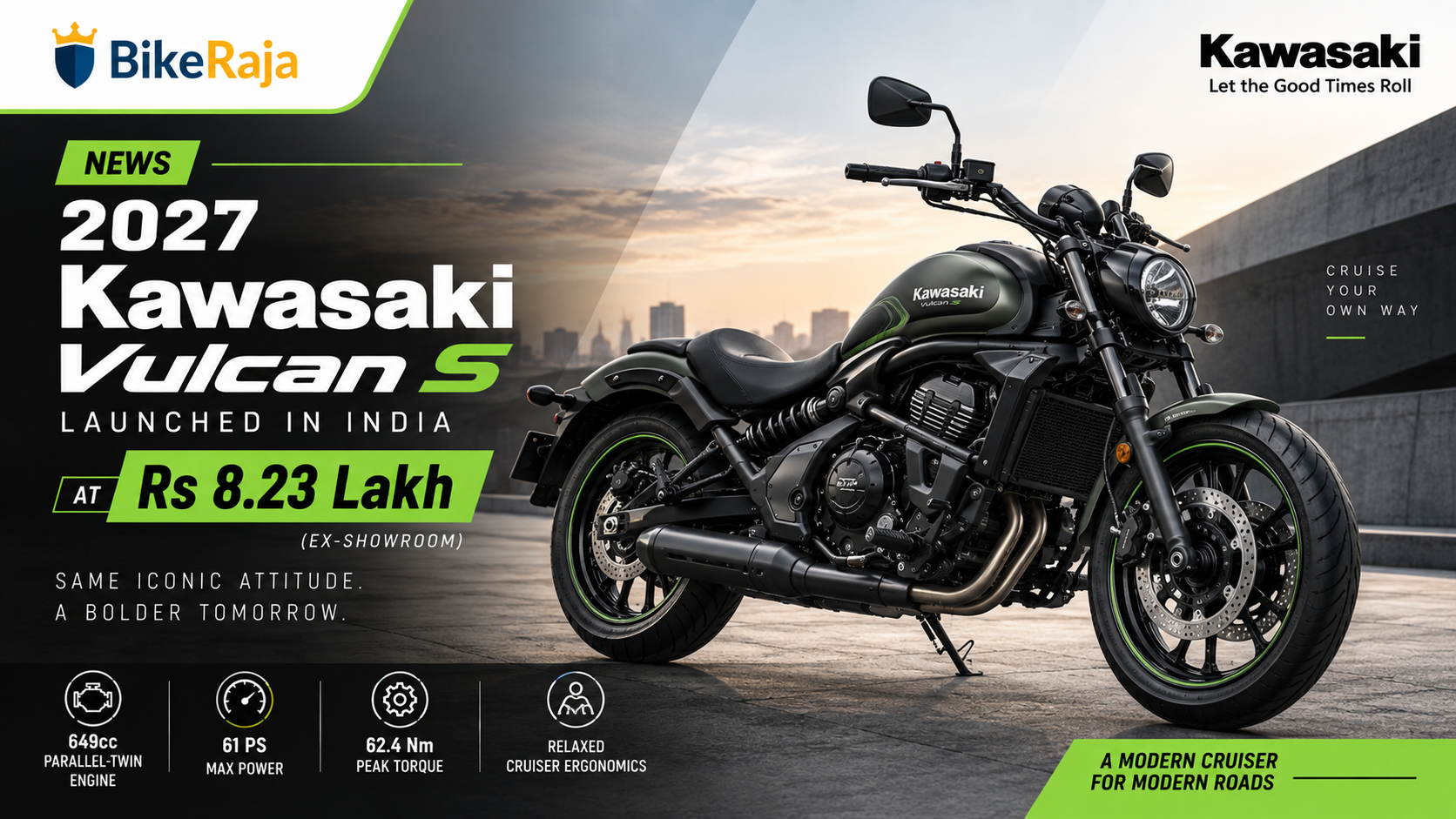
Kawasaki has launched the 2027 model-year update to the Vulcan S in India, priced at ₹8.23 lakh, ex-showroom — a modest ₹10,000 increase over the outgoing 2026 model's ₹8.13 lakh sticker price. Worth being upfront about this one: several outlets covering the launch have been fairly direct in describing it as a minor MY27 refresh rather than any kind of major update, and that framing holds up once you look at exactly what's changed. If you're expecting a substantially different motorcycle, you won't find one here — but there are a few small, genuinely worth-knowing tweaks under the surface.
What's Actually Changed
Three things have been updated for 2027: a small adjustment to the engine's torque output, a new dual-tone paint scheme, and — somewhat unusually for an "update" — smaller brake discs than the outgoing model offered. Everything else, including the core mechanical package, chassis, suspension, and feature list, carries over unchanged from the 2026 Vulcan S.
The Torque Story: Kawasaki Giving Back What It Took Away
This is a genuinely interesting little detail if you follow the Vulcan S's history closely. When Kawasaki updated the Vulcan S for the 2026 model year, the 649cc parallel-twin engine actually lost 1.4Nm of torque compared to the 2024 version, dropping to 61Nm. With this 2027 update, Kawasaki has simply restored that lost torque, bringing output back up to 62.4Nm at 6,600rpm — effectively returning the engine to where it was two model years ago rather than representing genuinely new performance. Peak power remains completely unchanged at around 60-61bhp at 7,500rpm, and there's been no change to the rev range at which either figure is delivered.
A Curious Change: The Brakes Actually Got Smaller
New Colour Option
The most visually obvious change is the paint job. The 2027 Vulcan S drops the 2026 model's single-tone Metallic Flat Spark Black in favour of a new dual-tone Metallic Carbon Gray finish with Metallic Bluish Green highlights — a subtle but genuine departure from the outgoing car's more understated black-only scheme.
Everything Else: Carried Forward Unchanged
Beyond those three points, the 2027 Vulcan S is mechanically identical to its predecessor. It continues to run the same 649cc, liquid-cooled, parallel-twin engine paired with a 6-speed gearbox, mounted in the same tubular diamond frame. Suspension duties are handled by telescopic forks up front and an offset laydown monoshock with preload adjustment at the rear. The bike also retains its adjustable clutch and brake levers, adjustable footpegs, and its existing analogue-digital instrument cluster combining a tachometer with a multi-purpose LCD display.
Full Spec Sheet
| Specification | Detail |
|---|---|
| Engine | 649cc, liquid-cooled, parallel-twin |
| Power | ~60-61 bhp @ 7,500 rpm (unchanged) |
| Torque | 62.4 Nm @ 6,600 rpm (up 1.4Nm from 2026) |
| Gearbox | 6-speed |
| Frame | Tubular diamond |
| Front Suspension | Telescopic fork |
| Rear Suspension | Offset laydown monoshock, preload adjustable |
| Front / Rear Brake | 272 mm / 216 mm disc (down from 300mm / 250mm) |
| ABS | Dual-channel, standard |
| Wheels | 18-inch front, 17-inch rear |
| Tyres | 120/70 front, 160/60 rear |
| Seat Height | 705 mm |
| Ground Clearance | 130 mm |
| Kerb Weight | 221 kg |
| Fuel Tank | 14 litres |
| Colour | Metallic Carbon Gray with Metallic Bluish Green (new) |
| Price (Ex-Showroom) | ₹8.23 lakh |
Where It Sits in the Market
The Vulcan S occupies a genuinely unusual position in India's cruiser landscape: it continues to have no direct rival. The closest comparison point most outlets draw is the Royal Enfield Super Meteor 650, but that comparison only goes so far, given the Super Meteor is priced at a considerably lower ₹4.05 lakh — roughly half the Vulcan S's asking price. Kawasaki India appears comfortable positioning the Vulcan S as a genuinely premium, mid-size cruiser without direct competition at this specific price point, rather than chasing a more crowded, value-driven segment.
Availability
Deliveries for the 2027 Vulcan S are scheduled to begin in mid-September 2026, giving buyers who've been waiting on this update a relatively short turnaround from launch to actually getting the bike.
The Bottom Line
If you're an existing Vulcan S owner or someone who's been closely following this specific model, the changes here are worth knowing but unlikely to be worth upgrading for on their own — a restored torque figure that simply undoes a previous reduction, a new colour, and smaller brakes don't add up to a compelling reason to trade in a 2026 model. For a first-time buyer coming to the Vulcan S fresh, none of this really changes the fundamental proposition: it remains the same distinctive, mid-size Kawasaki cruiser it's always been, now simply ₹10,000 more expensive and wearing a new coat of paint.
Team-BHP · Autocar India · Autocar Professional · BikeWale · BikeAdvice · ZigWheels · Auto India Daily · autoX