Hero XPulse 200 4V vs Kawasaki KLX 230: Full Comparison
Kunal Suvarna · 1 September 2026
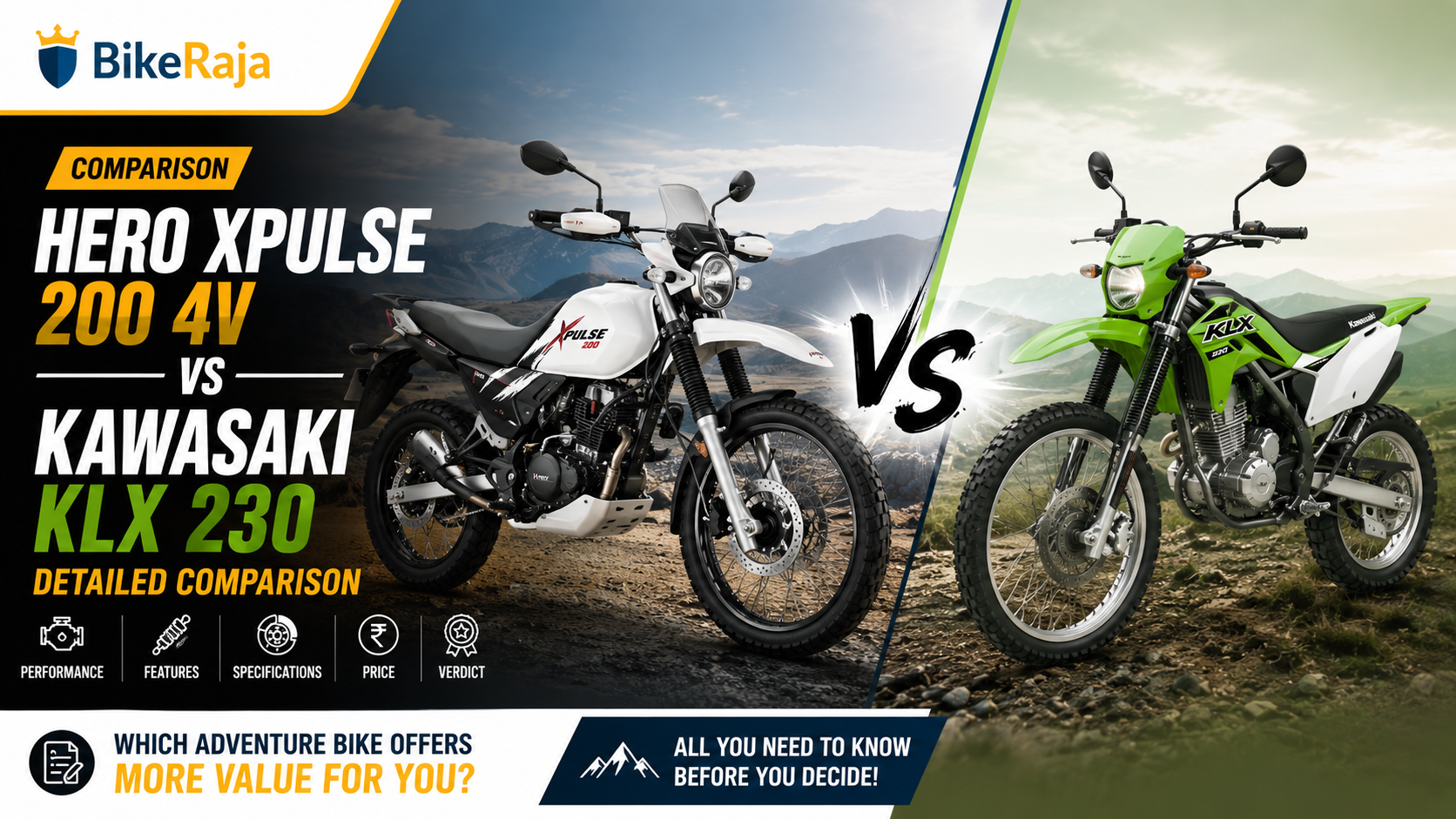
If you've spent any time browsing entry-level adventure motorcycles in India, you've probably already run into both of these names. The Hero XPulse 200 4V has been the default answer in this space for years now — the bike people recommend almost reflexively when someone says they want to try off-roading without spending a fortune. The Kawasaki KLX 230 is the newer, more serious-looking challenger, wearing a green livery that immediately signals "I mean business" to anyone who knows dirt bikes. On paper, they compete for the same rupee. In practice, they're solving slightly different problems, and figuring out which one solves your problem is really what this comparison is about.
Price: Not as Close as It Used to Be
As things currently stand, the Hero XPulse 200 4V starts at ₹1.48 lakh (ex-showroom) for the standard variant, climbing to ₹1.65 lakh for the Pro version. The Kawasaki KLX 230, meanwhile, is priced at ₹2.19 lakh (ex-showroom) across both its Standard and S variants. That works out to a gap of roughly ₹54,000 to ₹71,000 depending on which XPulse variant you're comparing against — a meaningfully smaller gap than when the KLX first launched at more than double the Hero's price, but still a real difference that most buyers will feel.
Engine and Performance
The two bikes take genuinely different approaches under the skin. The XPulse 200 4V runs a 199.6cc, air-cooled, four-valve single-cylinder engine, producing around 19.16bhp at 8,000rpm and 17.35Nm of torque at 6,500rpm, sent through a five-speed gearbox. The KLX 230 counters with a larger-displacement 233cc, air-cooled, two-valve single, putting out roughly 18.7-19bhp and about 19Nm of torque, paired with a six-speed gearbox — one extra ratio than the Hero offers.
On paper, that makes the two bikes look closely matched in outright power, with the KLX actually holding a slight torque advantage despite its simpler two-valve design. But numbers on a spec sheet only tell part of the story here, and this is one of those comparisons where real-world testing paints a noticeably different picture.
For everyday fuel economy, the KLX actually edges ahead too, with an ARAI-claimed 40kmpl compared to the XPulse's claimed 36kmpl — though real-world figures for both will vary considerably depending on how hard you ride and how much time you spend off-road.
Chassis and Handling: Where Their Personalities Really Show
This is arguably the most telling part of the comparison, because it's where each bike's underlying philosophy becomes obvious. The XPulse rides on a diamond-type frame, while the KLX uses a steel perimeter frame — generally considered the more purpose-built choice for serious off-road use. The XPulse also has a longer wheelbase than the Kawasaki, which tends to translate into better straight-line stability on highways and a more planted feel at speed. The KLX's noticeably shorter wheelbase, on the other hand, should make it feel more agile and eager to change direction on tight, technical trails — exactly where a shorter wheelbase becomes an advantage rather than a compromise.
Suspension setups differ too, though both use a telescopic front fork paired with a rear monoshock. The XPulse offers 250mm of front travel and 220mm at the rear, while the KLX (in its current, locally-built form) runs 220mm up front and 233mm out back on a Uni-Trak monoshock that's adjustable for preload. Braking hardware favours the Hero on paper, with a larger 276mm front disc against the Kawasaki's 265mm unit, while both share an identical 220mm rear disc.
Ground clearance is where the KLX asserts itself most clearly as the more off-road-focused machine, with figures in earlier reviews putting it around 265mm — roughly 45mm higher than the XPulse. That extra clearance is genuinely useful when you're picking your way over rocks, ruts, or anything else a proper trail throws at you. The trade-off is seat height: the KLX sits noticeably taller at 880mm in its standard form, versus the XPulse's far more accessible 825mm, which matters a lot if you're shorter or newer to bikes with this kind of stance. Worth noting, Kawasaki has since introduced an "S" variant with a lower seat and reduced suspension travel specifically to address this exact concern for shorter riders.
Design and Everyday Usability
Styling is always going to be subjective, but the two bikes clearly aim at different visual identities. The KLX leans hard into a stripped-back, hardcore dirt-bike look — slim, purposeful, and genuinely close in appearance to Kawasaki's non-road-legal off-road-only machines. It's the kind of bike that photographs well and grabs attention, but that focus comes with real trade-offs: a narrow, fairly firm seat that's not particularly kind to a second rider, and a much smaller 7.5-litre fuel tank that will have you stopping for petrol considerably more often than you would on the Hero.
The XPulse takes the opposite approach. It looks and feels more like a proper, complete road-legal motorcycle that happens to be very capable off-road when you want it to be, rather than a dirt bike wearing indicators as an afterthought. It comes with a proper LED headlamp, a much larger and genuinely usable 13-litre fuel tank — nearly double the KLX's capacity — and a seat big enough to comfortably carry a passenger. For anyone planning to use this as a daily commuter that occasionally goes off-road on weekends, rather than a dedicated trail bike that's merely road-legal, that difference in everyday practicality matters quite a lot.
Full Spec Comparison
| Specification | Hero XPulse 200 4V | Kawasaki KLX 230 |
|---|---|---|
| Engine | 199.6cc, air-cooled, 4-valve, single | 233cc, air-cooled, 2-valve, single |
| Power | ~19.16bhp @ 8,000rpm | ~18.7-19bhp @ 7,800rpm |
| Torque | 17.35Nm @ 6,500rpm | ~19Nm @ 6,200rpm |
| Gearbox | 5-speed | 6-speed |
| Frame | Diamond-type | Steel perimeter |
| Front Suspension Travel | 250mm | 220mm |
| Rear Suspension Travel | 220mm | 233mm (preload adjustable) |
| Front / Rear Brake | 276mm / 220mm disc | 265mm / 220mm disc |
| Seat Height | 825mm | 880mm (Standard) |
| Ground Clearance | ~220mm | ~265mm |
| Kerb Weight | ~159-161kg | ~139kg |
| Fuel Tank | 13 litres | 7.5 litres |
| Claimed Mileage (ARAI) | 36 kmpl | 40 kmpl |
| Colour Options | 6 | 2-3 |
| Price (Ex-Showroom) | ₹1.48L – ₹1.65L | ₹2.19L |
So, Which One Should You Actually Buy?
Honestly, this comparison isn't really about which bike is "better" in some absolute sense — it's about which one matches how you actually plan to ride. If your realistic weekly routine looks like commuting to work or college most days, running errands, occasionally carrying a friend, and heading off on a proper off-road trail maybe once or twice a month, the XPulse 200 4V is very likely the more sensible choice. It's cheaper, it'll go further between fuel stops, it's genuinely comfortable for two, and its lower seat height makes it far less intimidating for newer riders or anyone under six feet tall.
If, on the other hand, off-roading isn't an occasional weekend activity for you but the actual point of owning the bike — if you're chasing trails, technical terrain, and genuinely want something that feels closer to a proper dirt bike that's merely permitted on the road — the KLX 230 makes a much stronger case for itself, and Autocar's own testing backs that up with real numbers: it's quicker, lighter, and more focused everywhere it counts off-road. You'll pay more for that focus, live with a smaller tank, and probably won't be taking a pillion along very often, but if serious off-road capability is genuinely your priority, that trade-off may well be worth it.
The Bottom Line
The XPulse 200 4V remains the more complete, more practical, and considerably more affordable everyday motorcycle — it's earned its reputation as the default recommendation in this segment for good reason, and it continues to age well. The KLX 230 is the more focused, more capable off-road tool, and independent testing confirms it's genuinely quicker and more agile once the tarmac ends. Neither bike is wrong; they're just built for different versions of the same dream. The real question worth asking yourself isn't which bike is faster on a spec sheet — it's how often you'll actually be riding somewhere without a proper road under your wheels.
Autocar India · BikeDekho · BikeWale · 91Wheels · ZigWheels · Bike India · autoX · Team-BHP