Honda Bets Big on Flex-Fuel Two-Wheelers in India: ADV160 Signals a New Direction for Bikes and Scooters
BikeRaja News · 28 July 2026
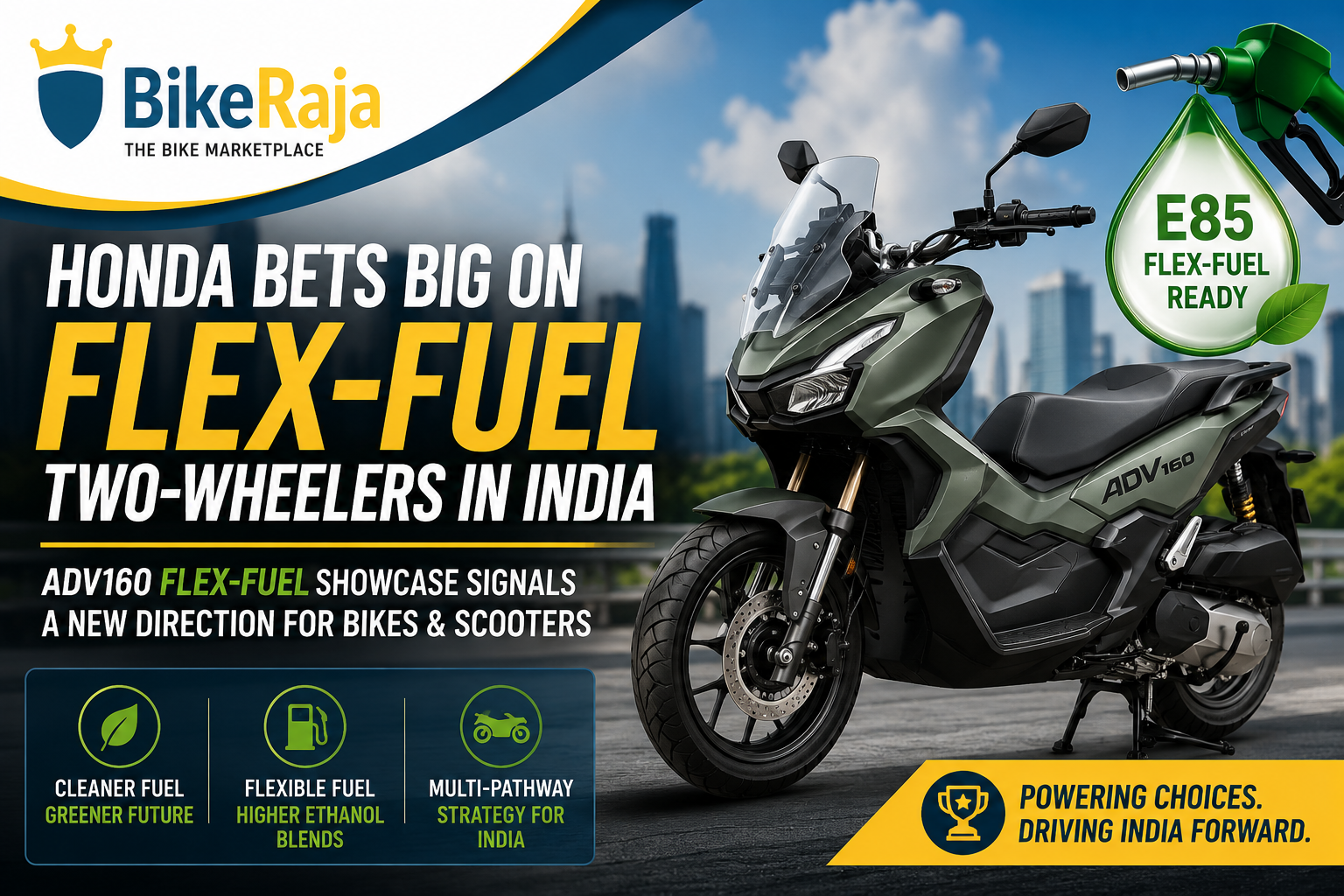
Honda Motorcycle & Scooter India is strengthening its focus on alternative-fuel technology, with flex-fuel set to remain an important part of the company’s future two-wheeler strategy in India. Following the showcase of an E85-compatible Honda ADV160, the manufacturer has made it clear that it is following a multi-pathway approach that includes conventional petrol engines, electric mobility and flex-fuel technology. The strategy could become increasingly significant as India looks to reduce its dependence on fossil fuels while giving consumers more mobility choices. India’s two-wheeler market is entering a period of major technological change.
Electric scooters are growing rapidly, manufacturers are introducing increasingly sophisticated motorcycles, and alternative fuels are becoming another important part of the conversation. Honda Motorcycle & Scooter India is now signalling that flex-fuel technology could play a meaningful role in that transition. Honda has reiterated its commitment to a multi-pathway strategy for India rather than focusing exclusively on battery-electric two-wheelers. Flex-fuel motorcycles and scooters form an important part of this approach, alongside petrol-powered products and electric vehicles.
One of the most interesting products demonstrating this strategy is the Honda ADV160 showcased with E85 flex-fuel compatibility. ### What Is the Honda ADV160 Flex-Fuel? The ADV160 is Honda’s adventure-style premium scooter. Its design combines the practicality of a scooter with visual elements normally associated with adventure motorcycles. The important development for India, however, goes beyond styling.
Honda has showcased an E85-compatible version of the ADV160, highlighting how its existing internal-combustion technology can potentially be adapted to operate on fuel containing a much higher proportion of ethanol. E85 generally refers to a fuel blend containing up to approximately 85 percent ethanol, with the remaining portion primarily consisting of petrol. That is significantly different from the ethanol-blended petrol commonly used by regular motorcycles and scooters. Running higher ethanol concentrations requires appropriate changes to components such as the fuel system, engine management and materials used in parts that regularly come into contact with the fuel.
Honda’s decision to showcase this technology demonstrates that the company sees alternative fuels as more than a short-term experiment. ### Honda Doesn't Want to Depend on Only EVs Electric scooters have become one of the fastest-changing parts of India's two-wheeler industry. However, Honda’s strategy suggests the company does not believe that India’s transition to cleaner mobility will necessarily depend on a single technology. Instead, different customers may require different solutions. Battery-electric scooters can make excellent sense for urban commuters who have predictable daily travel patterns and convenient access to charging.
Petrol motorcycles, meanwhile, continue to provide long-distance flexibility and extremely fast refuelling through India's huge existing fuel station network. Flex-fuel technology could potentially provide another option between these two approaches. This is especially relevant in India because motorcycles and scooters are not merely lifestyle products. For millions of people, they are essential transportation used for commuting, deliveries, small businesses and family mobility.
Any large-scale transition therefore needs to consider affordability, infrastructure and convenience in addition to emissions. ### Why Flex-Fuel Matters for India India imports a significant amount of the crude oil it consumes. Increasing the use of domestically produced ethanol can potentially help reduce the amount of conventional petrol required by the transport sector. Ethanol can be produced using agricultural feedstocks, creating another potential economic connection between India's transportation and agricultural sectors. The Indian government has already been pushing ethanol blending in petrol, making manufacturers increasingly interested in ensuring their engines remain compatible with changing fuel standards.
Flex-fuel vehicles go considerably further because they are designed to operate across a wider range of ethanol-petrol mixtures. This flexibility could become useful during a transition period when different fuel blends may coexist. For a rider, the fundamental idea is simple: instead of an engine being designed around one specific petrol blend, a flex-fuel vehicle is engineered to handle fuels containing substantially different proportions of ethanol. ### Honda's Wider Product Offensive The flex-fuel ADV160 is arriving at an interesting time for Honda in India. Honda recently unveiled an expanded portfolio of 10 motorcycles and scooters for the Indian market, including seven all-new models and three existing products receiving new colour options.
The lineup covers multiple categories including adventure, cruising, roadsters, lifestyle motorcycles, electric mobility and flex-fuel technology. This suggests Honda is preparing to compete much more aggressively across different areas of India's two-wheeler market. Rather than concentrating entirely on high-volume commuter motorcycles and scooters, the manufacturer appears interested in widening its presence in premium and lifestyle-oriented segments as well. Products such as the ADV160 are particularly interesting because India's premium scooter segment remains relatively small compared with the conventional scooter market.
Adventure-inspired scooters could attract riders who want everyday convenience but prefer something visually and functionally different from traditional family scooters. ### Flex-Fuel Motorcycles Are Becoming More Relevant Honda isn't exploring the technology in isolation. Flex-fuel motorcycles have gradually started appearing across the Indian two-wheeler industry as manufacturers prepare for the possibility of higher ethanol blends becoming increasingly important. That means future competition between motorcycle manufacturers may not revolve only around petrol versus electric. Consumers could eventually choose between several different technologies depending on their riding requirements.
For example, an urban commuter travelling 30–50 km per day might prefer an electric scooter because of its low running costs and ability to charge overnight. Someone travelling frequently between cities may continue preferring an internal-combustion motorcycle because of the availability and speed of refuelling. A flex-fuel motorcycle could offer another option where appropriate ethanol-blended fuel infrastructure is available. ### What Does Flex-Fuel Mean for Riders? For consumers, the biggest potential advantage is fuel flexibility.
A properly engineered flex-fuel engine can adjust its operation depending on the ethanol concentration of the fuel being used. However, ethanol has different energy characteristics compared with petrol. Higher ethanol blends can therefore affect fuel consumption, engine calibration and overall operating characteristics. This means consumers shouldn't simply put E85 into an ordinary petrol motorcycle unless the manufacturer explicitly states that the vehicle is compatible with that fuel.
Flex-fuel vehicles require purpose-designed or modified components. As the technology becomes more common, manufacturers will also need to clearly communicate fuel compatibility to owners. ### EVs Will Still Remain Important Honda's interest in flex-fuel does not mean the manufacturer is abandoning electric mobility. Quite the opposite. Honda is expanding its electric two-wheeler portfolio as well.
The company recently introduced the QC3 electric scooter for India, following its existing electric offerings. The QC3 has a claimed riding range of approximately 145 km on a single charge, giving Honda another product with which to compete in India's increasingly crowded electric scooter market. This demonstrates exactly what Honda means by a multi-pathway approach. Instead of making a single bet, Honda can simultaneously develop: Petrol motorcycles and scooters These continue serving India's massive conventional two-wheeler customer base.
Electric scooters These can target urban commuters looking for low running costs and zero tailpipe emissions. Flex-fuel two-wheelers These could help support India's ethanol strategy while retaining the familiar refuelling experience of an internal-combustion vehicle. ### Competition Is Getting Tougher Honda’s strategy also needs to be viewed against the increasingly competitive Indian market. Hero MotoCorp, TVS Motor Company and Bajaj Auto remain major forces in conventional motorcycles while simultaneously increasing their focus on electric mobility. Companies such as Ather Energy and Ola Electric have also helped accelerate competition in connected electric scooters.
TVS, Bajaj, Ather, Hero and Ola were among the leading electric two-wheeler manufacturers during June 2026, highlighting how quickly the EV segment is developing. For Honda, simply relying on the enormous popularity of products such as the Activa will not be enough to define its next decade. The company needs products covering new technologies, changing consumer preferences and emerging premium categories. That is why Honda's latest product offensive could prove particularly significant. ### Could Flex-Fuel Become Mainstream?
The biggest question is whether flex-fuel motorcycles and scooters will eventually become common on Indian roads. Much will depend on fuel availability, vehicle prices, consumer awareness and government policy. Consumers generally adopt new automotive technology when it offers a clear practical or financial advantage without creating additional inconvenience. For flex-fuel vehicles, widespread availability of suitable ethanol blends will therefore be extremely important.
Manufacturers will also need to ensure that the technology remains affordable for India's highly price-sensitive two-wheeler market. If these conditions are met, flex-fuel could become another meaningful part of India's transportation ecosystem rather than simply a transitional technology. ### Honda ADV160 Shows Where the Market Could Be Heading The E85-compatible Honda ADV160 is important not simply because it is a new scooter. It represents the wider transformation taking place across India's two-wheeler industry. For decades, buyers primarily compared motorcycles using factors such as engine capacity, mileage, performance and price.
Future buyers may have another decision to make before considering any of those factors: what type of powertrain or fuel should they choose? Petrol, ethanol-based flex-fuel and battery-electric vehicles could potentially coexist for years, each serving different types of riders. Honda's latest strategy suggests the company is preparing for exactly that scenario. For Indian motorcycle and scooter buyers, this increasing competition between technologies could ultimately be beneficial.
More manufacturers experimenting with different solutions should lead to greater choice, improved efficiency and increasingly sophisticated two-wheelers. The ADV160 flex-fuel showcase therefore represents more than another addition to Honda's portfolio. It offers an early indication of how one of India's largest two-wheeler manufacturers is preparing for a future where the fuel inside a motorcycle may become just as important as the motorcycle itself.